Music artists and their managers can find harmony with Facebook and other analytics by using Musicmetric Pro, a new release from Semetric.
Musicmetric Pro is an HTML5 web application, accessible on any browser, mobile phone, or tablet.
The app tracks activity on Facebook and other social networks for more than 650,000 artists and 10 million tracks in real-time, as well as web mentions, sentiment, and BitTorrent downloads.
Musicmetric is subscription-based, with the Pro version costing $79 per artist, per month, and the Lite version priced at $15.
Metrics include:
Likes and fan adds;Page views;Comments;Video and audio plays;BitTorrent file-sharing trends;Mentions of artists, bands, albums, and tracks in reviews or blogs; and Sentiment and buzz.
Semetric also offers Fantracker, a free product that allows access to social media, file sharing, and buzz trends for hundreds of thousands of artists, accessible by anyone.
Chief Executive Officer Gregory Mead said:
We have created one trusted place to be able to see all key artist information. In addition to the many data sources we provide, customers can also integrate their own data, including Facebook Insights, Google Analytics, and other data feeds such as digital sales, streams, or airplay into the Musicmetric dashboard with great ease. Sales and marketing teams now have dynamic and immediate insight into the effectiveness and impact of their online and offline marketing activities, over the entire ecosystem.
Tuesday, January 31, 2012

NOT PHISHING: Facebook Will Study Calls To Small Businesses
Small business page administrators are receiving emails that look an awful lot like phishing attempts but are actually legitimate product research by Facebook. A copy of one such email appears at the bottom of this post.
A new entry in Facebook’s help center says that the social network is conducting product research to “understand how many phone calls local businesses receive as a result of their Facebook page.”
Participants will receive a coupon for $500 in free advertising upon the completion of the one-month study. Sounds sweet, right?
Actually, that’s fair compensation, as participating businesses will receive a special phone number from Facebook to put on pages for the month so that the social network can count incoming calls while still routing them to the intended recipients.
Participating businesses won’t be able to tell which incoming calls are originating from their pages on Facebook, unless they ask the callers outright.
This sounds like a neat idea on Facebook’s part, especially if the social network releases the results afterward.
Thanks to Ryan Cohn, chief executive officer of What’s Next Marketing, for the tip.
Facebook May Register For IPO As Early As Wednesday [UPDATED]
Facebook may submit paperwork as early as Wednesday to register for an initial public offering that could be the largest of all time and make the social network one of the world’s most valuable companies.
“We’re not going to participate in IPO-related speculation,” said Jonny Thaw, a spokesperson for Facebook, via an email to us.
No one has been able to obtain on-the-record confirmation by any of the parties directly involved in the 12-digit deal.
However, scores of third party analysts have been talking on the record as if an IPO filing next week were a certainty.
The rumor first appeared in The Wall Street Journal, which said that Morgan Stanley might lead the underwriting, and that Goldman Sachs might play a major role.
We’ve asked the two investment banks for comment, although they both have a long history of complying with laws prohibiting discussion of imminent initial public offerings with the media before they occur.
This latest rumor jibes with another one we’d reported earlier this week about a three-day halt in processing trades of Facebook’s private shares that began this Wednesday.
The law firm that handles these transactions, Fenwick & West LLC, never responded to our request for comment when the news broke Tuesday and has yet to do so today.
Contacts at both SharesPost and SecondMarket, where the stock trades privately, declined to comment that day and did so again today.
The Journal puts the IPO valuation in the range of $75 billion to $100 billion, the lower end of which was the outcome of the last SharesPost auction, which closed at $34 per share one week ago.
Assuming the number of outstanding shares remains at 2.35 billion, Facebook’s current value is $79.9 billion.
Media coverage of the deal has included the fact that the competition for the underwriting has been so fierce over the past year that Morgan Stanley and Goldman Sachs have been offering to bring down their fees to as low as one percent of gross proceeds, which compares with seven percent for the typical deal.
Reuters learned that from James Montgomery, chief executive officer of the eponymous financial advisory company Montgomery & Company.
He said that even with the unheard-of low percentage rate for a fee, that would still yield something on the order of $100 million in revenues for the underwriters and put the lead bookrunner at the top of the rankings for the year.
Another competition is still underway between the New York Stock Exchange and Nasdaq for the privilege of listing the stock, for which the ticker has yet to be determined but could be something like FBOOK.
Monday, January 30, 2012
Timeline Launch Nears, But Few Users Like it, Survey Finds
Every Facebook change prompts a backlash, and this time it’s about the impending arrival of Timeline for all users of the social network. More than half of Facebook users say in a survey that they are worried about the change, while a minority said they like the Timeline feature, or are resigned with the fact that they’ll grow to like it.

The findings come from security research firm Sophos, which polled some 4100 Facebook users about Timeline. More than half say they are worried about the forced change, and more than 30 percent said they don’t know why they’re still on Facebook, the admittedly unscientific survey finds.
Almost 8 percent say they do like Timeline and just over eight percent said they guess they will get used to the new Facebook profile layout, which promises to turn your account into an online scrapbook where you can highlight important moments in your life. My PCWorld colleague Ian Paul has a great getting-started guide for Facebook Timeline.
Facebook announced Timeline in September, but the social network was slow to integrate it. At first, only a limited number of users could get the new profile setup, which later gave access to anyone who wanted it. Then, earlier this month, Facebook said all profiles will switch to Timeline over the next few weeks, whether they want it or not. Users have seven days to review everything that appears on your timeline before anyone else can see it.


It’s not the scrapbook element of Facebook Timeline that seems to tick people off, as much as new apps that automatically share your activity. Apps like Spotify, Washington Post, or Netflix post on your profile songs you listened to, stories you read, or movies you watched. Even all your check-ins are aggregated on a map, showing your recent travels to anyone with access to your profile, which is a concern for some.
Graham Cluley of Sophos explains: “I'm somebody who was never a rabid Facebook user, and have been well aware of the various risks that come along through sharing too much online, and yet the Facebook Timeline brought home to me just how much I had shared in the way of status updates, photographs, groups I had joined and ‘Like’s I had made.” Cluely says the poll results might be skewed because the kind of people who participate in Sophos’ polls are be more conscious of privacy and security-related issues.
If Facebook’s history of backlashes over changes is any indication, you should expect to see groups, campaigns, and the like to convince the social network not to force Timeline upon users. Facebook, however, has rarely nudged in front of user pressure, and given Timeline’s over-sharing concept is getting integrated deeper into the social network, chances are Timeline is something you will have to live with if you still wish to use Facebook.
The findings come from security research firm Sophos, which polled some 4100 Facebook users about Timeline. More than half say they are worried about the forced change, and more than 30 percent said they don’t know why they’re still on Facebook, the admittedly unscientific survey finds.
Almost 8 percent say they do like Timeline and just over eight percent said they guess they will get used to the new Facebook profile layout, which promises to turn your account into an online scrapbook where you can highlight important moments in your life. My PCWorld colleague Ian Paul has a great getting-started guide for Facebook Timeline.
Facebook announced Timeline in September, but the social network was slow to integrate it. At first, only a limited number of users could get the new profile setup, which later gave access to anyone who wanted it. Then, earlier this month, Facebook said all profiles will switch to Timeline over the next few weeks, whether they want it or not. Users have seven days to review everything that appears on your timeline before anyone else can see it.
It’s not the scrapbook element of Facebook Timeline that seems to tick people off, as much as new apps that automatically share your activity. Apps like Spotify, Washington Post, or Netflix post on your profile songs you listened to, stories you read, or movies you watched. Even all your check-ins are aggregated on a map, showing your recent travels to anyone with access to your profile, which is a concern for some.
Graham Cluley of Sophos explains: “I'm somebody who was never a rabid Facebook user, and have been well aware of the various risks that come along through sharing too much online, and yet the Facebook Timeline brought home to me just how much I had shared in the way of status updates, photographs, groups I had joined and ‘Like’s I had made.” Cluely says the poll results might be skewed because the kind of people who participate in Sophos’ polls are be more conscious of privacy and security-related issues.
If Facebook’s history of backlashes over changes is any indication, you should expect to see groups, campaigns, and the like to convince the social network not to force Timeline upon users. Facebook, however, has rarely nudged in front of user pressure, and given Timeline’s over-sharing concept is getting integrated deeper into the social network, chances are Timeline is something you will have to live with if you still wish to use Facebook.
When Facebook Goes Wall Street
Recently, the markets received a first inkling of an IPO filing from Facebook. Facebook's law firm -- tasked with reviewing and approving trades that occur on the secondary markets -- reportedly said that it would temporarily stop reviews on such secondary trades until next week.This is atypical, based on my experience as an Analyst at SecondMarket, one of the foremost secondary trading outfits for Facebook stocks. There was no such announcement ever made in my time working on the auctions for Facebook shares in 2010 and 2011. It's unlikely to me that the announcement has to do with mere operational updates, since auctions for Facebook shares have run smoothly every week for months.
So Facebook's IPO may be imminent. Not that we can't be patient. The public already knows that the day must come soon for Facebook to go public. That's because ever since Facebook crossed the 500 shareholder limit in 2011, they've made clear that an IPO will occur at least around April 2012.
As a startup enthusiast, Facebook's forthcoming IPO is exciting news. It means that another Web 2.0 company is growing up and ready for public market debut. It means there will be more opportunities for sustainable Web-based businesses to join the big leagues, because Facebook gives further verve to companies built online.
I'm bullish on Facebook's IPO debut. Facebook's revenue reportedly topped $4 billion in 2011. It's traded on the secondary markets at valuations around $70 billion to $80 billion. Qualitatively, I use the platform to communicate with friends and family everyday, and sense how pervasive it is in so many people's lives. As a marketer, I've used Facebook's advertising platform (from which most of Facebook's money reportedly books) to the tune of spectacular click-through rates on ads. Facebook has created immense value in the Developer ecosystem too.
Fellow entrepreneurs will be cheering alongside Facebook on the day it rings the opening bell, while secondary markets will have a superficial smile. If LinkedIn's IPO is any indication, secondary markets, like SecondMarket, will be satisfied that the debut share prices may validate the prices seen on the secondaries, however they won't be bringing out the bubbly to toast. Facebook is core to secondary market trading businesses. I estimate that Facebook represents upwards of 75% of all private company secondary share trading activity. Facebook is one of the few companies that accredited investors on these markets understand and covet. Facebook was the holy grail of the secondary markets.
A saving grace may be a market for IPO Lock Up shares though. Secondary markets like SecondMarket have announced attempts at such secondary markets for locked up shares, but it's unclear that they've made any headway in the process. And, if Facebook shares do perform tremendously well -- which they may -- the underwriters of the IPO themselves may waive the lock-up period for a block sale or special secondary trade, circumventing third-party efforts.
It'll be exciting for Facebook's employees and other shareholders nonetheless. One of my favorite parts of participating in the ecosystem of financial services for startups was getting to know the people SecondMarket had helped to make millionaires of each week. It's exciting when the value creation process results in personal wealth creation for the employees and other shareholders at these startups. I hope that despite going public, Facebook will be able to remain innovative and agile, continuing to feel like a startup. When I spoke with Paul Murphy of NYC cool startup Aviary a few weeks ago, he told me he thinks they'll be able to remain "scrappy."
"Facebook has plenty of cash but their office environment has kept the startup vibe," Murphy told me. "It doesn't feel super corporate. I have a lot of respect for startups who grow but keep their startup feel."
Here's hoping!
So Facebook's IPO may be imminent. Not that we can't be patient. The public already knows that the day must come soon for Facebook to go public. That's because ever since Facebook crossed the 500 shareholder limit in 2011, they've made clear that an IPO will occur at least around April 2012.
As a startup enthusiast, Facebook's forthcoming IPO is exciting news. It means that another Web 2.0 company is growing up and ready for public market debut. It means there will be more opportunities for sustainable Web-based businesses to join the big leagues, because Facebook gives further verve to companies built online.
I'm bullish on Facebook's IPO debut. Facebook's revenue reportedly topped $4 billion in 2011. It's traded on the secondary markets at valuations around $70 billion to $80 billion. Qualitatively, I use the platform to communicate with friends and family everyday, and sense how pervasive it is in so many people's lives. As a marketer, I've used Facebook's advertising platform (from which most of Facebook's money reportedly books) to the tune of spectacular click-through rates on ads. Facebook has created immense value in the Developer ecosystem too.
Fellow entrepreneurs will be cheering alongside Facebook on the day it rings the opening bell, while secondary markets will have a superficial smile. If LinkedIn's IPO is any indication, secondary markets, like SecondMarket, will be satisfied that the debut share prices may validate the prices seen on the secondaries, however they won't be bringing out the bubbly to toast. Facebook is core to secondary market trading businesses. I estimate that Facebook represents upwards of 75% of all private company secondary share trading activity. Facebook is one of the few companies that accredited investors on these markets understand and covet. Facebook was the holy grail of the secondary markets.
A saving grace may be a market for IPO Lock Up shares though. Secondary markets like SecondMarket have announced attempts at such secondary markets for locked up shares, but it's unclear that they've made any headway in the process. And, if Facebook shares do perform tremendously well -- which they may -- the underwriters of the IPO themselves may waive the lock-up period for a block sale or special secondary trade, circumventing third-party efforts.
It'll be exciting for Facebook's employees and other shareholders nonetheless. One of my favorite parts of participating in the ecosystem of financial services for startups was getting to know the people SecondMarket had helped to make millionaires of each week. It's exciting when the value creation process results in personal wealth creation for the employees and other shareholders at these startups. I hope that despite going public, Facebook will be able to remain innovative and agile, continuing to feel like a startup. When I spoke with Paul Murphy of NYC cool startup Aviary a few weeks ago, he told me he thinks they'll be able to remain "scrappy."
"Facebook has plenty of cash but their office environment has kept the startup vibe," Murphy told me. "It doesn't feel super corporate. I have a lot of respect for startups who grow but keep their startup feel."
Here's hoping!
App Hosts Charity Auctions On Facebook
When it comes to bidding on charity auction items, Facebook users won't have to leave the comforts of their favorite social networking site to do so anymore. Charity Bids, an organization that provides nonprofits fundraising platforms, announced the launch of Charity Auctions Tuesday, a Facebook application that enables nonprofits to host their auctions and events right on their page, without redirecting users to the organization's website.
"Few charities are properly utilizing the power of social media platforms such as Facebook," Israel Schachter, co-founder and CEO of Charity Bids, said in a release. "By making use of this simple fundraising app, charities will now be able to engage their supporters through their Facebook fan page, take advantage of Facebook's viral marketing tools and gain support from millions of people that are otherwise beyond their reach."
Though auctions only make up about 1 percent of philanthropic giving in the U.S., the New York Times reported earlier this year, experts say that it’s a great way to auction off big-ticket items that shoppers wouldn’t others have access to, such as meeting celebrities or buying a Mercedes that’s not yet on the market.
Tom DiNardo, chief executive and owner of DiNardo & Lord Auctioneers in Seattle, told the news outlet that when it comes to purchasing auction items, customers lean toward “experiential items that someone cannot go to the store and purchase.”
"Few charities are properly utilizing the power of social media platforms such as Facebook," Israel Schachter, co-founder and CEO of Charity Bids, said in a release. "By making use of this simple fundraising app, charities will now be able to engage their supporters through their Facebook fan page, take advantage of Facebook's viral marketing tools and gain support from millions of people that are otherwise beyond their reach."
Though auctions only make up about 1 percent of philanthropic giving in the U.S., the New York Times reported earlier this year, experts say that it’s a great way to auction off big-ticket items that shoppers wouldn’t others have access to, such as meeting celebrities or buying a Mercedes that’s not yet on the market.
Tom DiNardo, chief executive and owner of DiNardo & Lord Auctioneers in Seattle, told the news outlet that when it comes to purchasing auction items, customers lean toward “experiential items that someone cannot go to the store and purchase.”
Facebook Police Are Here
In September, Facebook rolled out their latest profile format -- the Timeline -- and in 2012 they've announced that every profile will be switched over to the new look. But what about people who like the old Facebook?What about people who barely check their profiles as it is? How're they going to find their way around and know how to keep up with the new social etiquette that will invariably evolve with all of the new features?
Easy. The Facebook Police!
Just a simple, totally-not-threatening little branch of law enforcement that the people over at "Jimmy Kimmel Live" have dreamed up to help us get through the transition more smoothly.
If you would like to watch, you can Click Here and search it on Youtube.
Easy. The Facebook Police!
Just a simple, totally-not-threatening little branch of law enforcement that the people over at "Jimmy Kimmel Live" have dreamed up to help us get through the transition more smoothly.
If you would like to watch, you can Click Here and search it on Youtube.
Internet Crime: Facebook Timeline Scams
In the next few weeks Facebook is going to force the rest of its 8-million users who haven't already, to switch to the "new and improved" Facebook Timeline profile format. Scammers are banking on the fact that many of you will hate this. Every time Facebook makes some kind of change to their operating system or display, the users (myself included) get annoyed. You can expect to see status updates from your friends (myself included) complaining about this new layout... Here's where the Internet predators swoop in.
You're going to see posts saying things like "Hate the new Facebook Timeline? Here's how to switch back to the old view." The sad truth is that this is just a spam hacker hoping you'll click some link so that they can access your account, install malware and start sending out spam across your beautiful new timeline, to all of your friends, in your good name.
Stop Internet spam criminals. Be prepared. Share this post with your friends and family and let them know that there is literally no way to avoid switching to the new Facebook Timeline view. Resistance if futile and if someone offers to help you get the old view back; it's a scam, DO NOT CLICK!
You're going to see posts saying things like "Hate the new Facebook Timeline? Here's how to switch back to the old view." The sad truth is that this is just a spam hacker hoping you'll click some link so that they can access your account, install malware and start sending out spam across your beautiful new timeline, to all of your friends, in your good name.
Stop Internet spam criminals. Be prepared. Share this post with your friends and family and let them know that there is literally no way to avoid switching to the new Facebook Timeline view. Resistance if futile and if someone offers to help you get the old view back; it's a scam, DO NOT CLICK!
Social Networking: The Endgame of Natural Communication
Original Article of Dori Hartley from Huffington post:
Somewhere between 'old hippie' and 'teenage gadget geek' you'll find a huge demographic that basically covers most of the computer-literate spectrum of humanity today. We range from those who lived through land-line telephones with rotary dials to those who wait in long lines on cold, wet days to pay hard earned cash for the next of the long-awaited iThingees. And some of us are one and the same.
We've seen the first through the most recent versions of everything -- the software, hardware, peripherals and apps. We are the people of the paperless account and we acquire our information digitally. While some crave the dirty analog sound of music recorded in days gone past, others download non-corruptible music files and torrents via controlled websites, both legally and illegally.
We are now pirates, gurus, authors, bloggers, thieves, anonymous, hackers, students, victims of fraud, angry verbal mobs or singular voices of reason. We provoke response with our videos and we recycle information as if it were our own original thought. We are rebels looking for a cause and we are the uninspired youth of today's America. We are lonely, desperate and frightened. We are artists and thinkers vying for a split second of the world's attention. We are the children who want more than a bleak vision of the future and we are the clamped, clogged, stubborn will of those who do their best to ensure its bleakness.
But we all have computers and access to the Internet, and this gives us so much more than just an opportunity to partake of the data -- it gives us a way to interact with it.
This is social networking. And where it was once fresh and exciting, filled with promise and the utopian dream of embracing giant planet Earth with a simple keystroke, it has now become -- after several long, technologically social and amazing years -- one cacophonous, noisy, unending explosion of human ego and pandemonium.
Once one reaches past the more deliberate forms of Internet communication (email, Skype, messenger chat) and ventures forth into the broad and almost limitless world of social networking, (Facebook, Twitter, Tumblr, MySpace and/or many of the social spin-off websites) the experience presents itself as immediately encouraging. Old friends, schoolmates and even family members seem to reunite out of nowhere. Suddenly, there's this virtual place from where you can create a new destiny.
You are no longer alone -- you now own a list of names that you believe are all real people, just like you... and each one of them is a potential friend, although, in the world of social networking, friendship is not relationship-based; it is about having an audience and being an audience. You make friends for entertainment purposes. You don't know it at the time, but that's all you end up being there for. Someone writes something clever, or stupid or inane -- and you react. And vice versa. And depending upon who you are, the presence of your updated words might turn those friends into a throbbing throng of devoted fans, a privileged mob selected to endure your moods and ravings, or perhaps a simple group of folks to occasionally yap with.
Whatever it is, it feels good and it feels good for a long time.
And then... it becomes a lifestyle, an addiction. Facebook and Twitter are now your life. You tweet while you're sitting on the toilet. You notice when one of your hundred or so fans drops off your Tumblr page.
One day, while you're still brave enough to leave the house to grab lunch with a friend, you find yourself discussing the status message of someone that the two of you have in common. Your lunch mate excuses himself for a moment and what do you do? You reach for your phone -- which is fully capable of receiving every possible update from every possible connection on every possible social network -- and check to see what's happening on Facebook, because that bowl of wonton soup will be ever so much more digestible if only you could be sure you weren't missing anything important.
And while you're there, you notice: Only one person liked your status -- and it's your mother. Oh, it's going to be a full day on Facebook, that's for sure.
A few weeks ago, I was forced to go zen. By this, I mean my Internet and phone service got messed up and plunged me into a two-week-long spin cycle of absolutely no social networking. Hell, I couldn't even receive a text or a phone call.
Imagine that? I actually had to use my brain again -- for entertainment! I had to live in the now, create for the moment, experience life without reporting back. I even... wait for it... read a book. It was awesome! I sat on my patio and took deep breaths, knowing that there was no excuse for me to go back in and hunker down by the computer (unless of course I wanted to work on my new novel -- but another day for that).
If there were roses, I swear I would have taken the time to smell 'em.
And it occurred to me: life goes on, whether I'm updating or not. And I go on, whether someone else is... or not.
When my service was finally restored, I cracked open Ye Olde Facebooke. It just wasn't the same, because something in me had changed in that short time away. I still saw the same non-stop complaints, kitty photos, status-go-rounds (you know the ones with the built-in guilt trips: "98% of you will not repost because you suck, blah, blah, blah"), inspirational quotes, etc. Some updates were shared and many were liked... but none of it was enough to keep me interested.
Because, in the two weeks that I didn't participate, I found something else: my life.
I like that. And I don't even have to click a button to make it real.
Somewhere between 'old hippie' and 'teenage gadget geek' you'll find a huge demographic that basically covers most of the computer-literate spectrum of humanity today. We range from those who lived through land-line telephones with rotary dials to those who wait in long lines on cold, wet days to pay hard earned cash for the next of the long-awaited iThingees. And some of us are one and the same.
We've seen the first through the most recent versions of everything -- the software, hardware, peripherals and apps. We are the people of the paperless account and we acquire our information digitally. While some crave the dirty analog sound of music recorded in days gone past, others download non-corruptible music files and torrents via controlled websites, both legally and illegally.
We are now pirates, gurus, authors, bloggers, thieves, anonymous, hackers, students, victims of fraud, angry verbal mobs or singular voices of reason. We provoke response with our videos and we recycle information as if it were our own original thought. We are rebels looking for a cause and we are the uninspired youth of today's America. We are lonely, desperate and frightened. We are artists and thinkers vying for a split second of the world's attention. We are the children who want more than a bleak vision of the future and we are the clamped, clogged, stubborn will of those who do their best to ensure its bleakness.
But we all have computers and access to the Internet, and this gives us so much more than just an opportunity to partake of the data -- it gives us a way to interact with it.
This is social networking. And where it was once fresh and exciting, filled with promise and the utopian dream of embracing giant planet Earth with a simple keystroke, it has now become -- after several long, technologically social and amazing years -- one cacophonous, noisy, unending explosion of human ego and pandemonium.
Once one reaches past the more deliberate forms of Internet communication (email, Skype, messenger chat) and ventures forth into the broad and almost limitless world of social networking, (Facebook, Twitter, Tumblr, MySpace and/or many of the social spin-off websites) the experience presents itself as immediately encouraging. Old friends, schoolmates and even family members seem to reunite out of nowhere. Suddenly, there's this virtual place from where you can create a new destiny.
You are no longer alone -- you now own a list of names that you believe are all real people, just like you... and each one of them is a potential friend, although, in the world of social networking, friendship is not relationship-based; it is about having an audience and being an audience. You make friends for entertainment purposes. You don't know it at the time, but that's all you end up being there for. Someone writes something clever, or stupid or inane -- and you react. And vice versa. And depending upon who you are, the presence of your updated words might turn those friends into a throbbing throng of devoted fans, a privileged mob selected to endure your moods and ravings, or perhaps a simple group of folks to occasionally yap with.
Whatever it is, it feels good and it feels good for a long time.
And then... it becomes a lifestyle, an addiction. Facebook and Twitter are now your life. You tweet while you're sitting on the toilet. You notice when one of your hundred or so fans drops off your Tumblr page.
One day, while you're still brave enough to leave the house to grab lunch with a friend, you find yourself discussing the status message of someone that the two of you have in common. Your lunch mate excuses himself for a moment and what do you do? You reach for your phone -- which is fully capable of receiving every possible update from every possible connection on every possible social network -- and check to see what's happening on Facebook, because that bowl of wonton soup will be ever so much more digestible if only you could be sure you weren't missing anything important.
And while you're there, you notice: Only one person liked your status -- and it's your mother. Oh, it's going to be a full day on Facebook, that's for sure.
A few weeks ago, I was forced to go zen. By this, I mean my Internet and phone service got messed up and plunged me into a two-week-long spin cycle of absolutely no social networking. Hell, I couldn't even receive a text or a phone call.
Imagine that? I actually had to use my brain again -- for entertainment! I had to live in the now, create for the moment, experience life without reporting back. I even... wait for it... read a book. It was awesome! I sat on my patio and took deep breaths, knowing that there was no excuse for me to go back in and hunker down by the computer (unless of course I wanted to work on my new novel -- but another day for that).
If there were roses, I swear I would have taken the time to smell 'em.
And it occurred to me: life goes on, whether I'm updating or not. And I go on, whether someone else is... or not.
When my service was finally restored, I cracked open Ye Olde Facebooke. It just wasn't the same, because something in me had changed in that short time away. I still saw the same non-stop complaints, kitty photos, status-go-rounds (you know the ones with the built-in guilt trips: "98% of you will not repost because you suck, blah, blah, blah"), inspirational quotes, etc. Some updates were shared and many were liked... but none of it was enough to keep me interested.
Because, in the two weeks that I didn't participate, I found something else: my life.
I like that. And I don't even have to click a button to make it real.
Facebook Teams Up To Target Spam
Facebook is partnering with Washington State to combat a type of spam called "clickjacking" that is plaguing the social networking site, company and state officials announced Thursday.
Two separate lawsuits were filed in federal courts in California and Washington state against Delaware-based Adscend Media LLC, which officials say is behind the spamming.
"The way we think about it, security is an arms race," Facebook's general counsel, Ted Ullyot, said alongside Washington state Attorney General Rob McKenna at the social media company's Seattle offices. "It's important to stay ahead of spammers and scammers."
In "clickjacking," links on Facebook promising shocking or salacious videos have code embedded in them that spreads the link to the user's page. That makes it seem like the user "liked" the link, with the aim of attracting more clicks from the user's friends. The links eventually lead users to a survey or information from an advertiser.
Adscend Media is spreading spam through misleading and deceptive tactics and has encouraged others to do the same, McKenna's office said.
An email inquiry sent to Adscend was not immediately returned, and an attorney for the company had not yet been listed in federal court records.
Social networking sites are popular targets for spammers because people are more likely to trust and share content that comes from people they know. This makes spam, scams and viruses easy to spread.
Still, Facebook says less than 4 percent of content shared on the site is spam. By comparison, about 74 percent of email is spam, according to security company Symantec Corp., though the bulk of it gets filtered out before reaching someone's inbox.
Facebook has more than 800 million users.
Named in Washington state's lawsuit are Adscend co-owners Jeremy Bash, of West Virginia, and Fehzan Ali, of Texas. The lawsuit says Adscend violated several state laws, as well as the federal CAN-SPAM act, which makes it unlawful to procure or initiate transmission of misleading commercial communication.
McKenna said Adscend has annual revenue of $20 million.
Washington state is the only state partnering with Facebook. The company said it partnered with Washington state because of a history in the state of technology consumer protection.
The attorney general said Washington state has been a leader in technology consumer protection since his predecessor, now Gov. Chris Gregoire, began filing suits against malware and spyware users.
"As spammers adjust their tactics, we adjust ours," McKenna said.
FBI Releases Plans To Monitor Social Networks
The US Federal Bureau of Investigation has quietly released details of plans to continuously monitor the global output of Facebook, Twitter and other social networks, offering a rare glimpse into an activity that the FBI and other government agencies are reluctant to discuss publicly. The plans show that the bureau believes it can use information pulled from social media sites to better respond to crises, and maybe even to foresee them.
Big Bank Competition Heats Up To Win Facebook IPO Prize
Facebook's initial public offering is likely to set a new standard for how low investment banks are willing to go on advisory fees to win big business.
The world's largest online social network is expected to tap public markets for $10 billion in the coming months in an offering that will value the company at up to $100 billion, according to sources familiar with the planned IPO. It will be one of the biggest U.S. market debuts ever, and a prized trophy for the investment bankers seeking to win lead advisory roles.
That has set up a fierce competition on Wall Street, particularly between the presumed front-runners Morgan Stanley and Goldman Sachs Group Inc, which may offer their underwriting services for as little as 1 percent of gross proceeds, bankers and industry observers said.
That would be far less than the 7 percent fee that smaller deals typically fetch, or the 2 or 3 percent that large deals tend to command.
"The Facebook IPO will be iconic," said James Montgomery, chief executive of San Francisco-based investment bank Montgomery & Co, which advises tech companies on mergers, acquisitions and private placements.
Facebook can easily negotiate a 1 percent fee for the entire group of investment banks that will peddle its shares, Montgomery said, "much to the chagrin of the underwriters."
Such a low fee is practically unheard of for investment banking deals, apart from the offerings of bailed-out companies General Motors Co, American International Group Inc and Ally Financial Inc, which sold shares held by the U.S. government in the aftermath of the financial crisis.
But Facebook has several advantages that will allow the company to haggle for a lower fee: it will be an easy sell as hoards of investors are keen to jump on the social media trend, and even a 1 percent fee would reap $100 million in revenue for investment banks, sending a lead advisor to the coveted No. 1 spot on IPO league tables.
"There's no other IPO like this," said Lee Simmons, a tech specialist at Dun & Bradstreet. "It's kind of the 800-pound gorilla for the tech sector."
The Wall Street Journal reported that Facebook plans to file IPO documents with U.S. securities regulators as early as Wednesday, and is close to picking Morgan Stanley as the lead underwriter.
The typical IPO that raises less than $500 million incurs a 7 percent fee -- what's known as "the 7 percent solution." But as IPOs grow in size, the fee percentage shrinks.
Investment banks usually earn fees of 4 percent to 5 percent on IPOs of more than $1 billion, but deals from Silicon Valley tend to carry a premium. U.S. tech IPOs of at least $1 billion carried an average fee of 5.8 percent from 2000 to 2012, on average, according to Thomson Reuters data.
In the case of Facebook -- whose T-shirt-wearing, 27-year-old chief executive, Mark Zuckerberg, is said to appreciate status updates more than stock brokers -- it's unlikely advisors will be able to command the standard rate.
"These Valley types think this whole process could be automated and they don't have to pay 7 percent to these flashy, French-cufflink-wearing Wall Street types," said Eric Jackson, founder and managing member of Ironfire Capital, a technology-focused hedge fund, who has interacted professionally with executives at Facebook and other social-media companies.
PRICING DILEMMA
Facebook's offering will be the largest ever IPO from Silicon Valley, as well as the largest global high-tech IPO since the dot-com bubble burst. The most recent U.S. social-media IPO, Zynga Inc, raised just one-tenth of the proceeds Facebook is hoping for.
Winning a lead advisory role on Facebook has become a make-or-break contest for tech bankers such as Goldman's George Lee, Morgan Stanley's Michael Grimes and Credit Suisse's Bill Brady.
Morgan Stanley and Goldman Sachs have been in communication with Facebook for months and already offered pitches to its executives in hopes of becoming lead adviser, according to sources briefed on the meetings.
Wall Street is now waiting to hear who will win the coveted "lead left" title, referring to where the top underwriter's name will appear on the IPO prospectus.
"Facebook is one of the most well-known brands around the globe," said George Papaioannou, a business professor at Hofstra University who has studied underwriting competition among investment banks. "The underwriters will have to do very little convincing to investors, and that gives Facebook a huge negotiating advantage."
Investment banking fees are not usually the primary concern for IPO candidates, who must nail down the right offering price and sell shares to the right mix of investors, Papaioannou said.
If the offering price is too high, the company and its underwriters risk burning IPO investors. If the bar is set too low, the stock issuer risks leaving money on the table. And if the mix is not right -- with more short-term traders than long-term investors -- a stock can become highly volatile in the days and weeks following its debut on an exchange.
Zynga, which makes some of the most popular online games that are played on Facebook, is a prime example. Co-managed by Goldman and Morgan Stanley, the IPO was priced at $10 a share in mid-December. IPO investors watched the stock fall 5 percent on the first day of trading. Zynga was quoted at $9.72 on Friday.
Similarly, online coupon-deals site Groupon Inc priced its IPO at $20 a share on November 4, but its shares fell as much as 26 percent in the first two weeks of trading. The stock was trading at $19.78 on Friday. Goldman, Morgan Stanley and Credit Suisse were co-managers of the IPO.
HANDLE WITH CARE
The other edge of the IPO sword can cut just as sharply for hot tech stocks.
LinkedIn Corp, which raised $353 million last May in an IPO priced at $45 a share, watched the stock soar as high as $122.70 on the first day of trading. LinkedIn shares have drifted down to the low $70 range, but the price range to date indicates that the company could have raised another $440 million to $1 billion in extra money if the IPO were priced more aggressively. Morgan Stanley was in the lead left position.
A sharp fluctuation in price soon after Facebook's IPO "would really embarrass Facebook and the underwriters," given the recent history of social-media IPOs, said Papaioannou
The Zynga, Groupon and LinkedIn deals garnered fees of 3 to 5 percent.
To be sure, the banks that are vying for a lead position on Facebook's IPO will have to do more than lowball on price. They will also have to convince the Palo Alto, California-based company that the deal will go off without a hitch.
As Facebook's size and influence have grown in recent years, its actions -- whether changes to privacy policies on its popular networking site, or its interactions with Wall Street bankers -- have come under intense public scrutiny.
Goldman's handling of a private sale of $1.5 billion worth of Facebook shares to wealthy clients last year stirred enough controversy that the bank was forced to limit the offering to non-U.S. investors.
That misstep may have cost Goldman some goodwill with Facebook, industry observers said. And, as a company that makes money from a broad base of users, it also forces Facebook to consider whether its IPO will give unfair advantages to well-heeled investors.
"Two reasons I think Morgan Stanley will get the lead: one, they have a great retail distribution platform with the Smith Barney franchise and, two, I don't think Facebook is overly happy with Goldman Sachs," said Jeff Sica, president and CEO of SICA Wealth Management, who has bought shares of Facebook in private, pre-IPO markets for clients.
Morgan Stanley was the top bookrunner for global high-tech IPOs last year, with $2.2 billion in global proceeds and 10.9 percent market share. It also led the pack in U.S. high-tech IPOs, according to Thomson Reuters data. Goldman Sachs was the runner up with $1.9 billion in global fees and 9.2 percent market share, and ranked No. 3 in U.S. high-tech IPOs behind JPMorgan Chase & Co.
A less measurable but equally important factor in obtaining the lead IPO position is whether bankers can connect with decision-makers at Facebook on a personal level.
"It's really going to be the banker that understands and is sensitive to Zuckerberg and the executive team's needs," said Dun & Bradstreet's Simmons. "Whoever does that successfully will get the bragging rights, the proverbial brass ring of tech IPOs."
The world's largest online social network is expected to tap public markets for $10 billion in the coming months in an offering that will value the company at up to $100 billion, according to sources familiar with the planned IPO. It will be one of the biggest U.S. market debuts ever, and a prized trophy for the investment bankers seeking to win lead advisory roles.
That has set up a fierce competition on Wall Street, particularly between the presumed front-runners Morgan Stanley and Goldman Sachs Group Inc, which may offer their underwriting services for as little as 1 percent of gross proceeds, bankers and industry observers said.
That would be far less than the 7 percent fee that smaller deals typically fetch, or the 2 or 3 percent that large deals tend to command.
"The Facebook IPO will be iconic," said James Montgomery, chief executive of San Francisco-based investment bank Montgomery & Co, which advises tech companies on mergers, acquisitions and private placements.
Facebook can easily negotiate a 1 percent fee for the entire group of investment banks that will peddle its shares, Montgomery said, "much to the chagrin of the underwriters."
Such a low fee is practically unheard of for investment banking deals, apart from the offerings of bailed-out companies General Motors Co, American International Group Inc and Ally Financial Inc, which sold shares held by the U.S. government in the aftermath of the financial crisis.
But Facebook has several advantages that will allow the company to haggle for a lower fee: it will be an easy sell as hoards of investors are keen to jump on the social media trend, and even a 1 percent fee would reap $100 million in revenue for investment banks, sending a lead advisor to the coveted No. 1 spot on IPO league tables.
"There's no other IPO like this," said Lee Simmons, a tech specialist at Dun & Bradstreet. "It's kind of the 800-pound gorilla for the tech sector."
The Wall Street Journal reported that Facebook plans to file IPO documents with U.S. securities regulators as early as Wednesday, and is close to picking Morgan Stanley as the lead underwriter.
The typical IPO that raises less than $500 million incurs a 7 percent fee -- what's known as "the 7 percent solution." But as IPOs grow in size, the fee percentage shrinks.
Investment banks usually earn fees of 4 percent to 5 percent on IPOs of more than $1 billion, but deals from Silicon Valley tend to carry a premium. U.S. tech IPOs of at least $1 billion carried an average fee of 5.8 percent from 2000 to 2012, on average, according to Thomson Reuters data.
In the case of Facebook -- whose T-shirt-wearing, 27-year-old chief executive, Mark Zuckerberg, is said to appreciate status updates more than stock brokers -- it's unlikely advisors will be able to command the standard rate.
"These Valley types think this whole process could be automated and they don't have to pay 7 percent to these flashy, French-cufflink-wearing Wall Street types," said Eric Jackson, founder and managing member of Ironfire Capital, a technology-focused hedge fund, who has interacted professionally with executives at Facebook and other social-media companies.
PRICING DILEMMA
Facebook's offering will be the largest ever IPO from Silicon Valley, as well as the largest global high-tech IPO since the dot-com bubble burst. The most recent U.S. social-media IPO, Zynga Inc, raised just one-tenth of the proceeds Facebook is hoping for.
Winning a lead advisory role on Facebook has become a make-or-break contest for tech bankers such as Goldman's George Lee, Morgan Stanley's Michael Grimes and Credit Suisse's Bill Brady.
Morgan Stanley and Goldman Sachs have been in communication with Facebook for months and already offered pitches to its executives in hopes of becoming lead adviser, according to sources briefed on the meetings.
Wall Street is now waiting to hear who will win the coveted "lead left" title, referring to where the top underwriter's name will appear on the IPO prospectus.
"Facebook is one of the most well-known brands around the globe," said George Papaioannou, a business professor at Hofstra University who has studied underwriting competition among investment banks. "The underwriters will have to do very little convincing to investors, and that gives Facebook a huge negotiating advantage."
Investment banking fees are not usually the primary concern for IPO candidates, who must nail down the right offering price and sell shares to the right mix of investors, Papaioannou said.
If the offering price is too high, the company and its underwriters risk burning IPO investors. If the bar is set too low, the stock issuer risks leaving money on the table. And if the mix is not right -- with more short-term traders than long-term investors -- a stock can become highly volatile in the days and weeks following its debut on an exchange.
Zynga, which makes some of the most popular online games that are played on Facebook, is a prime example. Co-managed by Goldman and Morgan Stanley, the IPO was priced at $10 a share in mid-December. IPO investors watched the stock fall 5 percent on the first day of trading. Zynga was quoted at $9.72 on Friday.
Similarly, online coupon-deals site Groupon Inc priced its IPO at $20 a share on November 4, but its shares fell as much as 26 percent in the first two weeks of trading. The stock was trading at $19.78 on Friday. Goldman, Morgan Stanley and Credit Suisse were co-managers of the IPO.
HANDLE WITH CARE
The other edge of the IPO sword can cut just as sharply for hot tech stocks.
LinkedIn Corp, which raised $353 million last May in an IPO priced at $45 a share, watched the stock soar as high as $122.70 on the first day of trading. LinkedIn shares have drifted down to the low $70 range, but the price range to date indicates that the company could have raised another $440 million to $1 billion in extra money if the IPO were priced more aggressively. Morgan Stanley was in the lead left position.
A sharp fluctuation in price soon after Facebook's IPO "would really embarrass Facebook and the underwriters," given the recent history of social-media IPOs, said Papaioannou
The Zynga, Groupon and LinkedIn deals garnered fees of 3 to 5 percent.
To be sure, the banks that are vying for a lead position on Facebook's IPO will have to do more than lowball on price. They will also have to convince the Palo Alto, California-based company that the deal will go off without a hitch.
As Facebook's size and influence have grown in recent years, its actions -- whether changes to privacy policies on its popular networking site, or its interactions with Wall Street bankers -- have come under intense public scrutiny.
Goldman's handling of a private sale of $1.5 billion worth of Facebook shares to wealthy clients last year stirred enough controversy that the bank was forced to limit the offering to non-U.S. investors.
That misstep may have cost Goldman some goodwill with Facebook, industry observers said. And, as a company that makes money from a broad base of users, it also forces Facebook to consider whether its IPO will give unfair advantages to well-heeled investors.
"Two reasons I think Morgan Stanley will get the lead: one, they have a great retail distribution platform with the Smith Barney franchise and, two, I don't think Facebook is overly happy with Goldman Sachs," said Jeff Sica, president and CEO of SICA Wealth Management, who has bought shares of Facebook in private, pre-IPO markets for clients.
Morgan Stanley was the top bookrunner for global high-tech IPOs last year, with $2.2 billion in global proceeds and 10.9 percent market share. It also led the pack in U.S. high-tech IPOs, according to Thomson Reuters data. Goldman Sachs was the runner up with $1.9 billion in global fees and 9.2 percent market share, and ranked No. 3 in U.S. high-tech IPOs behind JPMorgan Chase & Co.
A less measurable but equally important factor in obtaining the lead IPO position is whether bankers can connect with decision-makers at Facebook on a personal level.
"It's really going to be the banker that understands and is sensitive to Zuckerberg and the executive team's needs," said Dun & Bradstreet's Simmons. "Whoever does that successfully will get the bragging rights, the proverbial brass ring of tech IPOs."
To Be Free, Twitter Must Not Be Free
What makes social media an interesting field to study and follow is that you simply can't predict what will happen next; it's a world where things change every moment, where a simple 'tweet' could reach millions with a press of a button and a Facebook page could help bring down governments. The one thing that was always constant was that most people believed that humanity has finally developed a medium that is truly democratic, in the sense that is it is free from any means of control or influence which could prevent a message from reaching the masses as it was intended by the sender.
People, including yours truly, often ridiculed those who spoke of conspiracy theories that there is a person or an organization which pushes a certain agenda across sites like Twitter or Facebook.
Of course, there were always the 'acceptable' measures which very few of us ever complained about, such as the removal of graphic or obscene content . Every now and then, there would be a particular page or tweet removed but this just didn't occur enough to become an issue.
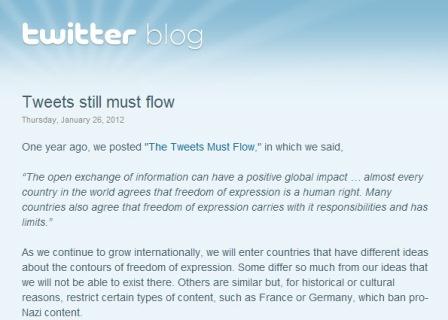
(Declaration of Non-Independence? Twitter announces its new censorship strategy)
This was all true until the recent Twitter announcement that tweets can now be censored on a country-by-country basis, allowing posts that may be deemed problematic in one country to still appear in another.
As soon as the news broke, many 'tweeps' have expressed their severe disappointment with the decision and have accused the site of censorship. The hashtags #twittercensorship and #twitterblackout were quickly formed by users who are planning to protest by not tweeting on Jan. 28 in a stand against what they see as a threat to freedom of expression and information.
Now, what will be the outcome of such a boycott movement and whether or not it will be successful in reversing Twitter's decision is something which only time will be able to tell.
What is certain is that users would have had much more impact if they were paying for the service, as only then would Twitter be forced to listen to their demands; at the end of the day, no business would ever risk upsetting its customers.
And this is exactly the bottom line, we -- the users -- are not Twitter's 'customers'; albeit we are the beneficiaries of the service, we forget that Twitter is not a charity... it still needs to make money and this money comes from advertisers.
Twitter, like Google before it, needs to go to new markets and attract new investors and advertisers. Obviously, these markets are not all democratic -- when Google went to China (a market nobody can ignore) they had to alter their service to be able to reach a certain arrangement with the local authorities in order for them to be able to operate. (Google later removed filters from search results in a decision which didn't go down to well with the Chinese government.)
Now, I am all for "Glocalization" and I absolutely understand that McDonald's is well advised not to serve beef in India or pork in Saudi Arabia, but when it comes to social media services, we are not talking about a Happy Meal; we are talking about the freedom of speech and the freedom to access information -- things which we should all be equal in.
If the likes of Twitter start imposing censorship techniques to please governments, firms or organizations, then they will quickly become no different than the mind-numbing state-owned media outlets of the Middle East's former dictatorships.
In fact, if Twitter or any of these sites which we have come to love and rely on think that they have become irreplaceable, then they should learn from these exact same Middle East dictators that nobody is ever too big to fall.
However, I am not one of those commentators who preach all day without providing a solution -- I think Twitter should simply charge for its service and become totally advertising-free; it is true that countries will still ban it but people will find a way to connect. In addition, those who pay will have the right to choose if they want to remain on the service or leave if they find the content unsuitable for them. I for one who will be happy to pay for my censorship-free connection.
People, including yours truly, often ridiculed those who spoke of conspiracy theories that there is a person or an organization which pushes a certain agenda across sites like Twitter or Facebook.
Of course, there were always the 'acceptable' measures which very few of us ever complained about, such as the removal of graphic or obscene content . Every now and then, there would be a particular page or tweet removed but this just didn't occur enough to become an issue.
(Declaration of Non-Independence? Twitter announces its new censorship strategy)
This was all true until the recent Twitter announcement that tweets can now be censored on a country-by-country basis, allowing posts that may be deemed problematic in one country to still appear in another.
As soon as the news broke, many 'tweeps' have expressed their severe disappointment with the decision and have accused the site of censorship. The hashtags #twittercensorship and #twitterblackout were quickly formed by users who are planning to protest by not tweeting on Jan. 28 in a stand against what they see as a threat to freedom of expression and information.
Now, what will be the outcome of such a boycott movement and whether or not it will be successful in reversing Twitter's decision is something which only time will be able to tell.
What is certain is that users would have had much more impact if they were paying for the service, as only then would Twitter be forced to listen to their demands; at the end of the day, no business would ever risk upsetting its customers.
And this is exactly the bottom line, we -- the users -- are not Twitter's 'customers'; albeit we are the beneficiaries of the service, we forget that Twitter is not a charity... it still needs to make money and this money comes from advertisers.
Twitter, like Google before it, needs to go to new markets and attract new investors and advertisers. Obviously, these markets are not all democratic -- when Google went to China (a market nobody can ignore) they had to alter their service to be able to reach a certain arrangement with the local authorities in order for them to be able to operate. (Google later removed filters from search results in a decision which didn't go down to well with the Chinese government.)
Now, I am all for "Glocalization" and I absolutely understand that McDonald's is well advised not to serve beef in India or pork in Saudi Arabia, but when it comes to social media services, we are not talking about a Happy Meal; we are talking about the freedom of speech and the freedom to access information -- things which we should all be equal in.
If the likes of Twitter start imposing censorship techniques to please governments, firms or organizations, then they will quickly become no different than the mind-numbing state-owned media outlets of the Middle East's former dictatorships.
In fact, if Twitter or any of these sites which we have come to love and rely on think that they have become irreplaceable, then they should learn from these exact same Middle East dictators that nobody is ever too big to fall.
However, I am not one of those commentators who preach all day without providing a solution -- I think Twitter should simply charge for its service and become totally advertising-free; it is true that countries will still ban it but people will find a way to connect. In addition, those who pay will have the right to choose if they want to remain on the service or leave if they find the content unsuitable for them. I for one who will be happy to pay for my censorship-free connection.
Curating Facebook: Finding Meaning in the Noise
If you're like me, Facebook is both a blessing and a curse.
As more and more people that I'm connected with join Facebook, the more I find Facebook both valuable and noisy.
The truth is some of my actual friends are folks who I'm glad to be connected with, but I might be happier if I could tone down, or tune out, some aspects of their Facebook broadcast.
With this in mind, I've developed a solution for how to curate my Facebook newsfeed. I know the word 'curate' may not be familiar to you in this context, but in the new world of too much data -- organizing and filtering information is critically important.
What I'm going to suggest is a series of steps that I think may help you make Facebook more useful and interesting.
Step One: Determine who your friends are.
I've made a decision that I don't 'friend' anyone I haven't met at least once in person. They don't have to be best friends, or even close friends. But I do want a human relationship to exist before a digital one.
With that in mind, I do like having a broad range of friends from many parts of my life. School, social, business, and my volunteer work. I reach out broadly, knowing that I can curate my newsfeed with tools that Facebook makes to help dial up and down different voices and topics.
Step Two: I give all friends the benefit of the doubt.
When I first 'Friend' someone, I subscribe to all their posts, and all the sub-topics of their posts. Rather than make guesses about what they may share that is interesting, I open my ears and listen to what they have to share. Politics, movies, news, personal life info -- I'll check it all out.
Step Three: Narrowing the stream.
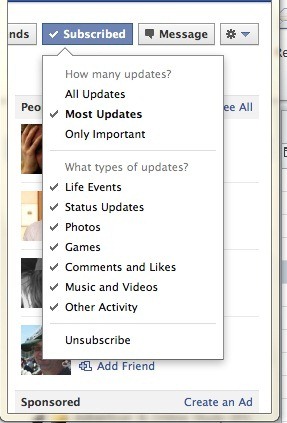
Pretty quickly I know who's simply over-sharing. The first step in curation is to narrow the flow from "all updates" to "most updates". This slows the volume of posts from a friend. Sometimes that's enough to keep my newsfeed with a healthy mix of voices and posts.
Step Four: Event Types.
Sometimes, narrowing the feed isn't enough. Sometimes I find my business friends share more personal info than I need to know. In this case, unsubscribing to "life events" can do the trick. And, I almost always unsubscribe to games. I'm just not into the various versions of Farmville.
Step Five: Facebook Groups.
With Facebook Groups, you can create lists such as "Work", "Family", or "Drinking Buddies", and add whichever friends you want. You can then send emails to the group or post to a shared wall space. Groups replaces the 'lists' feature, which wasn't widely used. Facebook is now set up so new friends are driven to be categorized by Groups, better I think than Google+'s 'circles' feature.
The only thing about groups to be aware of is by default, all members of a Facebook group get email notifications about everything -- including all messages and wall posts. Pretty quickly this feels like spam.
But you can limit notifications as well -- click on Account on the Facebook home page, then the Account Settings drop-down. Click the Notifications and scroll to Groups. From there you can curate Group-related activity results in email alerts. You can even curate notifications for an individual group.
Facebook is big, and getting bigger. So don't feel despondent about the fact that you're having trouble managing the stream of data that Facebook is sending at you. It's not you - it's them. How big? Facebook reports having 800 million active users. Just to give you some perspective, Europe, with Russia included, has a population of 727 million. Yeah, it's big.
So, imagine being on a conference call with 800 million of your 'friends' -- that's just not going to work.
The answer is curation. Using the tools that Facebook has deployed to filter, manage, and organize who you're listening to, and how often their messages are getting through.
One big benefit of curating your Facebook feed is that as you dial down the noise, you'll find some of your more interesting friends who don't update as aggressively start to make their way into your newsfeed. That's a wonderful surprise.
As more and more people that I'm connected with join Facebook, the more I find Facebook both valuable and noisy.
The truth is some of my actual friends are folks who I'm glad to be connected with, but I might be happier if I could tone down, or tune out, some aspects of their Facebook broadcast.
With this in mind, I've developed a solution for how to curate my Facebook newsfeed. I know the word 'curate' may not be familiar to you in this context, but in the new world of too much data -- organizing and filtering information is critically important.
What I'm going to suggest is a series of steps that I think may help you make Facebook more useful and interesting.
Step One: Determine who your friends are.
I've made a decision that I don't 'friend' anyone I haven't met at least once in person. They don't have to be best friends, or even close friends. But I do want a human relationship to exist before a digital one.
With that in mind, I do like having a broad range of friends from many parts of my life. School, social, business, and my volunteer work. I reach out broadly, knowing that I can curate my newsfeed with tools that Facebook makes to help dial up and down different voices and topics.
Step Two: I give all friends the benefit of the doubt.
When I first 'Friend' someone, I subscribe to all their posts, and all the sub-topics of their posts. Rather than make guesses about what they may share that is interesting, I open my ears and listen to what they have to share. Politics, movies, news, personal life info -- I'll check it all out.
Step Three: Narrowing the stream.
Pretty quickly I know who's simply over-sharing. The first step in curation is to narrow the flow from "all updates" to "most updates". This slows the volume of posts from a friend. Sometimes that's enough to keep my newsfeed with a healthy mix of voices and posts.
Step Four: Event Types.
Sometimes, narrowing the feed isn't enough. Sometimes I find my business friends share more personal info than I need to know. In this case, unsubscribing to "life events" can do the trick. And, I almost always unsubscribe to games. I'm just not into the various versions of Farmville.
Step Five: Facebook Groups.
With Facebook Groups, you can create lists such as "Work", "Family", or "Drinking Buddies", and add whichever friends you want. You can then send emails to the group or post to a shared wall space. Groups replaces the 'lists' feature, which wasn't widely used. Facebook is now set up so new friends are driven to be categorized by Groups, better I think than Google+'s 'circles' feature.
The only thing about groups to be aware of is by default, all members of a Facebook group get email notifications about everything -- including all messages and wall posts. Pretty quickly this feels like spam.
But you can limit notifications as well -- click on Account on the Facebook home page, then the Account Settings drop-down. Click the Notifications and scroll to Groups. From there you can curate Group-related activity results in email alerts. You can even curate notifications for an individual group.
Facebook is big, and getting bigger. So don't feel despondent about the fact that you're having trouble managing the stream of data that Facebook is sending at you. It's not you - it's them. How big? Facebook reports having 800 million active users. Just to give you some perspective, Europe, with Russia included, has a population of 727 million. Yeah, it's big.
So, imagine being on a conference call with 800 million of your 'friends' -- that's just not going to work.
The answer is curation. Using the tools that Facebook has deployed to filter, manage, and organize who you're listening to, and how often their messages are getting through.
One big benefit of curating your Facebook feed is that as you dial down the noise, you'll find some of your more interesting friends who don't update as aggressively start to make their way into your newsfeed. That's a wonderful surprise.
Facebook Timeline Looms: What You Need to Know
Soon Facebook users who have been avoiding the social network’s Timeline feature won’t be able to stave it off any longer and will be seeing their profiles change considerably. That’s because Facebook is making Timeline compulsory and is rolling it out to users in the next couple of weeks.
You should be aware of several things before the launch. Here's how to prepare.
Are Your Posts Viewable by Strangers?
Instead of a linear stream of your posts, the new Timeline is a visual aggregation of everything you’ve ever done on the site: the information you’ve included on your profile, your photos, everything you’ve ever “liked,” any Facebook apps you’re using, a map showing where you’ve been (according to geo-tagged posts and photos), as well as a Timeline of everything you’ve ever posted.
The problem is that Facebook seems bent on making all of that data more public. Now any post that you make defaults to Public, so if you forget to choose “friends” in the inline audience selector when you post something, the entire world can see it.
That’s why it’s very important that you check out how your Timeline looks when other people view it. You may find that many of the posts you intended for your friends are public.
To see how your Timeline looks to strangers, click on the small gear just below the right corner of your cover (the spot where you can place a large banner photo at the top of your Timeline). From the gear, click View As. From there, you’ll be able to preview your public Timeline.
To make sure your past posts are limited to friends, click on the small arrow on the top right corner of your Timeline. Then go to Privacy Settings>> Limit the Audience for Past Posts>>Manage Past Post Visibility and select Limit Old Posts. Alternately, you can change the audience by clicking on the small pencil icon at the top right of individual posts to edit or hide them from the Timeline.
Once you get Timeline you only have seven days to make changes to it, such as hiding old posts from years ago that you may not want the world to see, or managing the visibility of your posts.
So if you’re someone who doesn’t check into Facebook often, you might want to proactively get Timeline now and then sit down to review it and make changes.
Several privacy groups are urging the Federal Trade Commission to look into whether Facebook oversteps its authority with Timeline, but in the meantime, it's up to you to check your privacy settings.
Facebook Wants More of Your Data
Another thing that the new feature lets you do is add events from any part of your past -- all the way back to birth, if you want -- to create an online scrapbook of your entire life.
If you’re not sure what kinds of things you should add, Facebook has plenty of ideas. Inside your Timeline you can click on Life Event in your status bar and you’ll be asked to categorize your entry into one of these headings: Work & Education, Family & Relationships, Home & Living, Health & Wellness or Travel & Experiences.
Within each category is a slew of suggestions. For instance, under Home & Living, you can choose: Moved, Bought a Home, Home Improvement, New Roommate, New Vehicle and Other Life Event.
Can you imagine all the new data Facebook is going to be accumulating from users? The reason, of course, is to laser target ads at people. But some people don’t like the idea of Facebook having such rich profiles about individual users on file.
Some Security Concerns
Security firm Sophos polled 4000 Facebook users, asking them what they think of the new Timeline and the response was overwhelmingly negative, with 51 percent saying the feature worries them and another 32 percent saying they don’t know why they’re still on Facebook.
For one thing, with more of your data possibly accessible by strangers, it may be easier for criminals to profile people and glean personal information.
The reality is that personal data is very valuable to criminals. For example, with enough information a bad guy can impersonate someone in order to do things like pull off phishing scams.
In its Naked Security blog, Sophos points out that once they see all their data clumped in one place many Facebook users are shocked at how much information about themselves they’ve posted online.
Another thing that might make you uncomfortable is the map included in Timeline that shows where you hang out. If you don’t want people seeing that information, make sure to go back to any geo-tagged posts or photos and either change the location or hide it from the Timeline.
See more: Protect Your Facebook Account From the Latest Hack
Timeline Fans Exist, Too
Not everybody is going into paranoid mode with the rollout of Timeline and some people really like it.
PCWorld’s Jared Newman believes that in time, Facebook users will come to like Timeline. The downside, he points out, is that users must do some cultivating to bring their most relevant life details to the surface.
Subscribe to:
Posts (Atom)